North Korea launches trash balloons towards South Korea for fifth day
North Korea sent more trash balloons toward South Korea on Sunday, the South's military said, in what marked the fifth straight day of such launches.
Leftovers, fruit peels, kitchen scraps — we toss them into the trash without a second thought. But where does it all go once the garbage collector takes it away?




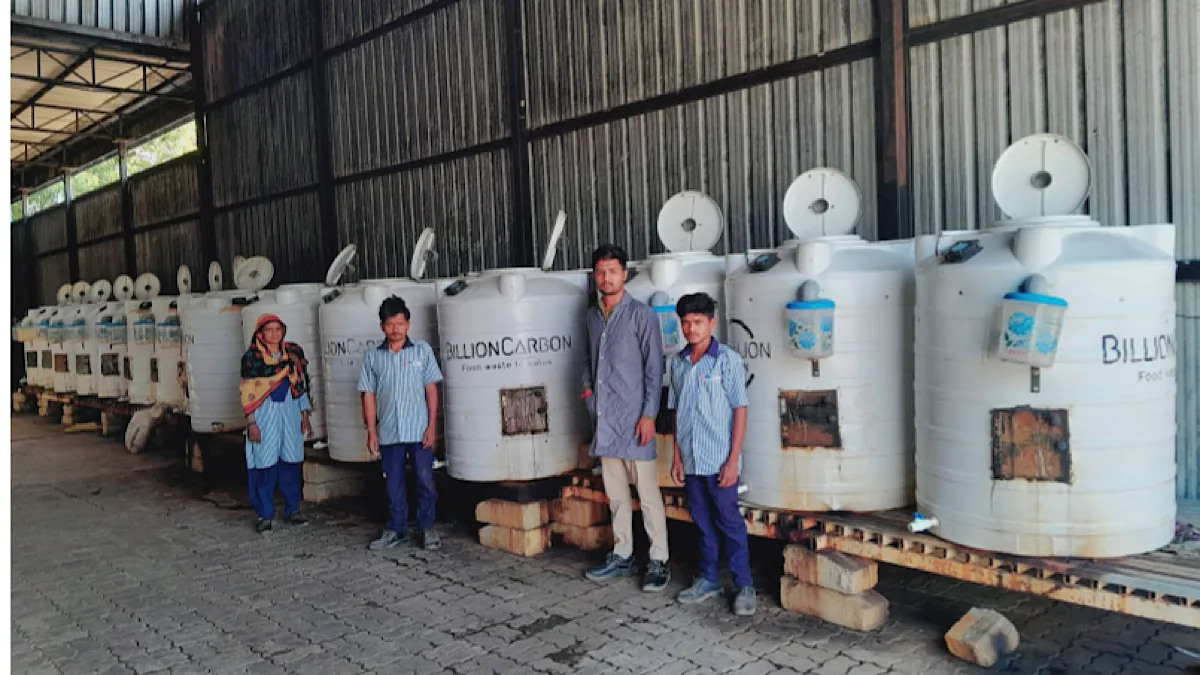
Photo:SNS
Leftovers, fruit peels, kitchen scraps — we toss them into the trash without a second thought. But where does it all go once the garbage collector takes it away?
In most Indian cities, the journey ends in overflowing landfills, where rotting food waste releases methane, a greenhouse gas far more potent than carbon dioxide.
Advertisement
This everyday problem caught the attention of siblings Ankita and Nikhil Vijayvergiya, engineers-turned-entrepreneurs hailing from the city of Ahmedabad. The duo co-founded BillionCarbon, a startup tackling food waste with a mission to turn trash into opportunity.
Advertisement
Motivated by their concern for the environment, they began managing all the kitchen waste in their own home.
“Conscious of waste in our household, Nikhil and I started composting and growing our own food six years ago, ensuring that no organic waste left our home for the landfill,” Ankita Vijayvergiya said in an email to The Statesman.
What began as a small home experiment — growing vegetables and composting scraps — took on new urgency during the pandemic, when the global food crisis laid bare how broken the system was.
As they dug deeper, they found that conventional methods — from landfills to biogas plants — were riddled with inefficiencies. The systems were slow to process, expensive to maintain, and too scattered to handle the scale of the problem.
Determined to turn a twin crisis into an opportunity, Ankita and Nikhil began scouring global waste management models in 2020 — the year the idea for BillionCarbon took root. They studied more than 100 approaches and spent nearly three years experimenting with different methods. By 2023, after successful pilots with industry players like Adani and public bodies such as the Bhopal Municipal Corporation, the siblings officially launched their company.
Their goal was clear: to create a solution that was affordable, scalable, and sustainable. With support from a team of research scientists ranging from civil engineers to soil microbiology experts, they developed a technique that converts everyday food waste into high-quality bio-fertiliser in just three days.
BillionCarbon targets bulk waste generators — industries and establishments that produce upwards of 0.5 tonnes per day. These include corporates, manufacturing units, and even residential townships, all of which are mandated by the Government of India to manage their waste within their premises under the Solid Waste Management Rules, 2016.
At first glance, the technology appears deceptively simple: a row of 1,000-litre white water storage tanks, like the ones often seen on urban rooftops, arranged side by side with spouts and collection containers attached. But inside these seemingly ordinary tanks is a breakthrough innovation—a Micro-Climate-Controlled Bioreactor that uses a mix of micro and macro organisms to fully break down food waste in just three days.
Unlike traditional composting, which can take over a month, this system ensures complete aerobic decomposition in a fraction of the time. It’s designed to handle all types of food waste — from fruits and vegetables to dairy, grains, meat, and baked goods — and operates right where the waste is generated, whether in corporate parks, hotels, food and beverage industries, or municipalities. That means no transportation costs, no reliance on landfills, and no waste left behind.
BillionCarbon’s system runs at nearly half the cost of conventional composting technologies like Organic Waste Composter (OWC) machines. With operational costs as low as ₹2 to ₹3 per kilogramme, the set-up requires minimal electricity and no transportation, making it both affordable and sustainable.
“We train the ground staff to run the system daily, and each site is assigned a skilled supervisor,” said co-founder Ankita Vijayvergiya. “Worker safety and health are our top priorities.”
The difference is already being felt on the ground. “It doesn’t feel like working in a waste treatment site,” said one staffer. “Earlier, I used to have 3–4 sick days a month when I worked with OWC machines that produced sludge. Now, it’s zero.”
Advertisement